
Introduction
The global market for agricultural machetes is very competitive. Two manufacturing giants dominate the scene: China and India. International buyers must understand the differences between these countries. Technical requirements for specific crops and regional rules are also vital. This article outlines a successful B2B procurement strategy. The Dynamics of Global Sourcing Sourcing from overseas requires careful planning. You must consider lead times, quality control, and shipping costs. Choosing the right partner can give your business a major edge.
Machete Price Comparison: China vs. India Manufacturers
Price is often the first consideration for procurement agencies. However, you must also look at production capability and quality.
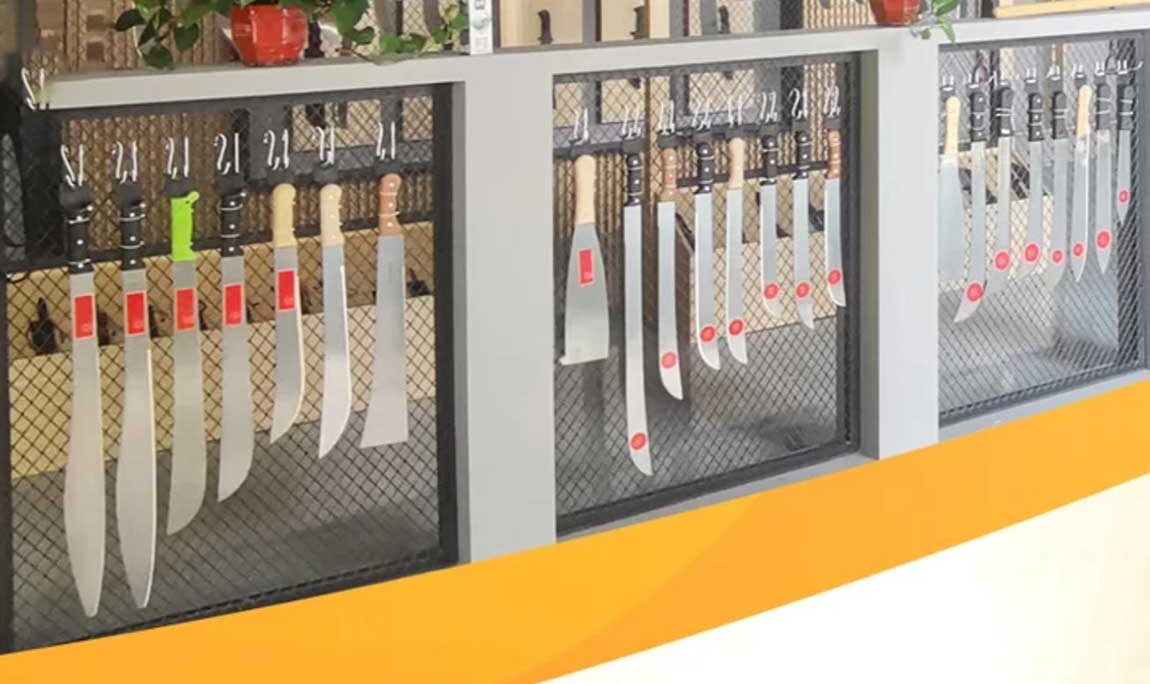
• China (Cost and Scale): China holds the advantage in economies of scale. Chinese factories are highly automated. This allows for lower prices on massive orders of 10,000+ units. They also offer modern handle materials like rubber.
• India (Material and Tradition): Indian makers often use recycled railway steel. Some markets believe this offers better “spring” and toughness. Indian prices are competitive for smaller, specialized batches.
• The Verdict: For high-volume tools with modern looks, China is best. For niche markets with traditional needs, India is a good choice. Evaluating Production Automation ensures consistency in every blade. This is critical for large-scale agricultural projects. Automated factories have fewer defects and faster production cycles.
Specialized Farm Tools: Machete for Cutting Banana Trees
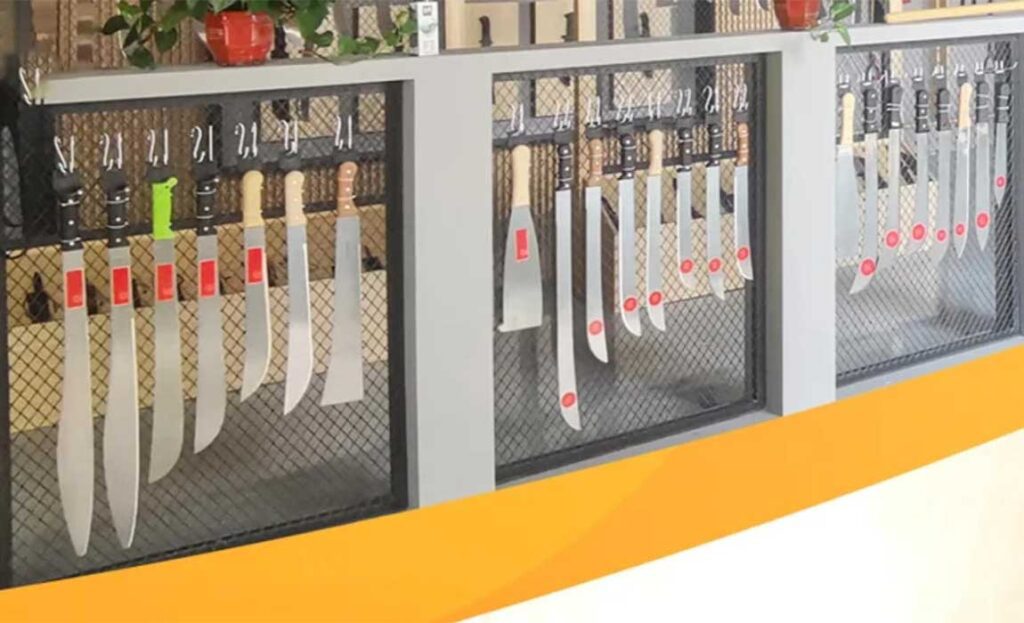
Banana cultivation requires a very specific set of tools. Banana “trees” are actually giant herbs with soft stalks. A standard machete might get stuck in the fleshy plant.
The ideal banana machete features:
• Thin, Wide Blades: A thin blade (1.5mm – 1.8mm) reduces friction. This helps it slice through the stalk easily.
• Extreme Sharpness: The blade must be kept at a “razor” edge. Look for makers who provide a high-precision factory grind.
• Curved Design: Some regional banana knives have a slight curve. This helps with the specific cuts required during harvesting.
Maintaining a Razor Edge
Educate your customers on how to maintain these specialized blades. A sharp tool is safer and more efficient for the worker. Proper sharpening tools should be sold alongside the machetes.
Identifying Wholesale Machete Suppliers with Fast Shipping
In the B2B world, “time is money.” Delays in delivery can disrupt entire planting seasons. Fast shipping is a major competitive advantage for any supplier.
Criteria for fast-shipping suppliers:
1. Stocked Inventory: Some large makers keep “buffer stock” of popular models. This allows for shipping within 7-10 days.
2. Proximity to Major Ports: Choose suppliers near hubs like Ningbo or Shanghai. This reduces inland transit time significantly.
3. Digital Logistics Integration: Modern suppliers offer real-time tracking for your orders. They have strong ties with Tier-1 freight forwarders.
Digital Tracking for Global Shipments
Knowing exactly where your container is helps with inventory planning. It allows you to update your customers on delivery dates. Transparency in logistics builds trust between you and your supplier.
Material Science: Which Steel is Best for Machete Sharpness?
A machete is only as good as the steel used. For B2B buyers, the “best” steel balances edge life with ease of sharpening.
• 65Mn (Manganese Steel): This is the most common steel for high-quality tools. It offers great toughness and decent edge retention. It is the industry standard today.
• 1055/1075 High Carbon Steel: These are used by premium brands. They hold a sharp edge longer but can rust more easily.
• Stainless Steel: This is rarely used for serious farm work. It is too brittle and very hard to sharpen in the field.
Navigating Machete Export Regulations and Africa Import Duties
Exporting tools to Africa involves a complex web of rules. You must account for these to keep your deals profitable.
• Pre-Shipment Inspections: Nations like Nigeria require a Certificate of Conformity (CoC). This ensures tools meet local safety standards.
• Import Duties: Duties on hand tools can range from 5% to 25%. Some countries offer waivers for agricultural equipment.
• Restricted Items: Some regions classify machetes as potential weapons. You may need specific licenses from the Ministry of Agriculture.
Key points for bulk cane machete orders:
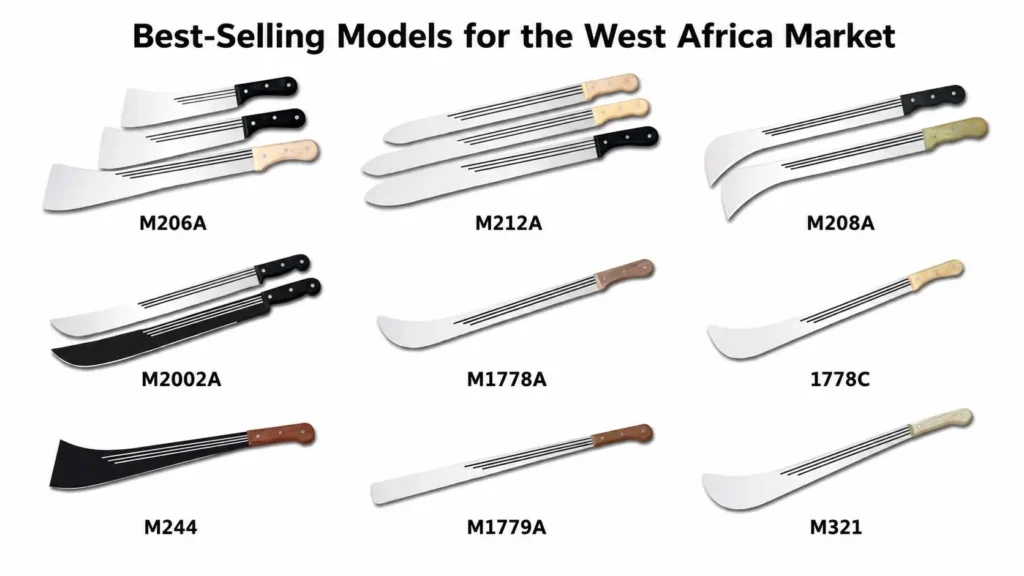
Hooked Tips:
- Many cane machetes have a small hook at the end. This is used for pulling dead leaves away from the stalk.
Balanced Weight:
- Large farms need tools that are perfectly balanced. This prevents strain injuries among the harvesting laborers.
Bulk Pricing:
- Negotiate “tiered pricing” based on your annual volume. This helps stabilize costs for the farm and the supplier.
Machete China Factory Direct Export and MOQ Requirements
Sourcing directly from a China factory maximizes your profit margins. However, these deals come with Minimum Order Quantity (MOQ) rules.
Typical MOQs:
- Factories usually require
2,000 to 5,000 units
for export prices.
Consolidation:
- If you cannot meet the MOQ, try a “mixed container” strategy. Combine 2-3 different models to reach the total volume requirement.
Payment Terms:
- The standard is usually 30% T/T deposit. The remaining 70% is paid upon presentation of the Bill of Lading.
Sourcing the Best Machete for Heavy-Duty Gardening
There is a big B2B market for heavy-duty gardening tools. These are sold through landscaping contractors and garden centers.
The best machete for this segment has:
Polypropylene Handles:
- These do not crack or rot in wet conditions. They provide a secure grip even when the user’s hands are wet.
Shorter Blades:
- A 12 to 14-inch blade is often preferred for gardening. It offers better control in confined spaces than longer versions.
Sheath Options:
- Offering durable nylon sheaths is a major selling point. It ensures safety and ease of transport for the professional.
Packaging for Small Retail Outlets
Wholesalers often sell to small hardware shops. Provide packaging that is ready for retail display. This makes your products more attractive to local store owners.
Conclusion
Understand global dynamics from material science to trade law. This helps B2B professionals build a resilient supply chain. Focus on quality, speed, and compliance for long-term success.
Whatsapp : (+86 18830227232) E-mail : inquiry@ganzhedao.com